Labels

Arundhati Roy, Tyeb Mehta, Michael Jackson, Kipling, Rushdie, Jinnah, Leonard Cohen, Anita Desai, Kiran Desai, East India Company, Namdeo Dhasal, etc

Monday, March 31, 2008

Adding clay, subtracting stone


The Times of India, March 31

Nina Martyris meets Dhruva Mistry, the sculptor who has held only one job in his life

Initially reticent, he gradually warms to the flame. As the conversation with Dhruva Mistry progresses, you learn to watch out for his dry-as-tinder remarks, delivered quietly with an anticipatory glee. His observations have a sharp edge to them but a pleasing snap as well. Alas, the more interesting ones are made off the record.

The Baroda-based Mistry is visiting Mumbai as the Artist of Focus at the Harmony Art show, an annual exhibition helmed by Tina Ambani, now in its 13th year.

With his sparse grey hair, unremarkable spectacles, and quiet clothes that would meld obediently into the linoleum decor of any corporate pit, Mistry is a far throw from the stereotype of sculptor as wildhaired, rumpled maverick attacking huge cubes of stone.

Beneath that HR-friendly exterior, naturally, a fierce individualism thumps alongside an idealism whose edges have been singed with cynicism. A devotee of the Gandhian prescription of self-knowledge and self-sufficiency, he has held only one job in his life—as Dean of Fine Arts at Baroda’s M S University (1999 to 2002). He resigned in two years repelled by a system which considered it kosher for diploma holders to lecture to postgraduates and where a government-anointed stooge demanded the respect due to a savant.

Which is why when Mistry happened to meet another victim of the system, Verghese Amul Kurien, at an airport, a remark by the milk cooperative visionary sloshed in his head. Kurien had said, “The biggest hurdle in the way of India’s development is the bureaucracy. The bureaucrats are the biggest employed trade union in the country.’’

At the Harmony show, 29 of his works—paintings and sculpture—are on display but all of them are from the last ten years of his career. Given that the 1957-born sculptor (“You can say I am running 51 or 51 run-out, it doesn’t matter’’) has been at it for at least 30 years, the selection does not track his evolution from lusciously formed figures to a more distorted, abstract idiom. But that is how he wanted it.

What the exhibition does showcase is diversity, the unifying factor of Mistry’s vast oeuvre.From the unforgiving hardness of stone to the craven softness of chalk, from
fashionable fibre-glass and polished stainless steel to rusty metal and good old wood, Mistry has worked with a distractingly varied range. Perhaps this is only natural for the boy who started out with anything he could lay his hands on—paper, wood, twigs and leaves assembled with the glue from the neem trees in his village of Kanjari.

“The material varies but the goal doesn’t,’’ he says. “I choose the best material depending on what I want to say. With clay you add things; with stone you subtract; with steel you add and subtract or weld; you use alabaster if you want a just-before-glass look; bronze is an expensive medium given the labour and metal costs.’’

Superlatives are scrupulously absent from Mistry’s opinions as is the sweeping pronouncement. He is wary of big anthems like freedom of expression, and adds wearily that few are ready to acquaint themselves with the nitty gritty of the problem. For instance, he says, Chandramohan, the Baroda art student who was arrested for his exam submission of a cross with a commode below and a goddess berthing a full-grown man, was a print-maker and had no business submitting an installation in the first place. And while he has no patience for puffed-up custodians of culture with their tilaks and cellphones, he is as unimpressed by liberals who dismiss him as an old-fashioned stickler for rules.

Encomia like “great artist’’ and “genius’’ are abstained from. “I don’t think any artist should go through what Husain is going through,’’ he says in response to how a great artist like Husain has been hounded out of his own country. “We are more a thrashing democracy than a thriving one.’’ As are judgmentalisms such as “young artists are being ruined by all that auction money’’. “Matisse came from a well-off background, that did not diminish anything, in fact the subjects of his paintings are at ease, at repose. So being commercially successful doesn’t make art good or bad.”

“To appreciate art you don’t have to be a critic—even a good journalist can do the job.” He cites Hemingway’s gripping reportage of the bullfights, told in spare prose with no flesh on the bone. “But you must remain a spectator. Art, like bullfighting is a gory business.” He adds wickedly after a pause, “I can use many other adjectives to describe the art scene.”

Monday, March 3, 2008

Remember Nikki Gandhi Bedi?


The Sunday Times of India, Times Review, March 2, 2008

Nina Martyris meets her in a rehab called time

Nikki Bedi is vacationing in Mumbai after an epic gap of two long years during which so much has happened. Ex-husband Kabir Bedi has acquired a new girlfriend, schoolmate Elizabeth Hurley has married a chiselled Bombay mannequin, and there are far too many Indian blondes around now. The diminutive 41-year-old, with the loud, cut-glass diction of a British chat show host, has taken these scattered changes in her stride—Kabir’s girlfriend, Parveen, is described with gushing warmth as “simply fantastic”, the fake blondes are dissed, eyes rolling, as “declassé”, Liz Hurley doesn’t trigger any early schoolroom memories.

On a February morning that has no redeeming winter nip, Nikki has set out from the Intercontinental Hotel for her power walk. By eight o’clock it is boiling but she has already rounded the salty curve of the seafront and conquered the steep shoulder of Walkeshwar to finally halt at a deeply personal public shrine, a standardissue shiny black municipal plaque etched in gold lettering with the name Sumant Moolgaokar Chowk.

Her late grandfather—the legendary Tata chief after whom it is rumoured the Sumo was named—lived at Mayfair Apartments, easily one of Malabar Hill’s most distinguished addresses. This is where the young Nikki spent her holidays, chasing cousins and siblings up and down the broad corridors, while Dadu with his Hasselblad and meticulous eye captured it all on film. Nikki is in Mumbai this time to “water her roots”. She has spent the afternoon in Juhu with Kabir and Parveen, and his daughter Pooja Bedi and her children (there’s a lot of watering going on here).

She asks permission to light up a Gudang Garam, throwing in that she had given up in May and should probably give up again. Life in Birmingham is demanding. She runs a radio show (Asian Network) and a TV show (Desi DNA), and this means reading at least three books a week, watching two films, and if there’s a band on the show, downloading and listening to all their music, “legally, may I add”. She is obsessive compulsive when it comes to research, she says, and though she has a team, prefers to do the slog herself. There is a research ban on Wikipedia for its sometimes dodgy information—for instance, on her page, her first husband Sunil Vijaykar is described as an economist, when in fact he is a food stylist or, at a stretch, a food economist. And when she googles, she does a “reverse google”, beginning on Page 9 rather than Page 1 because that’s how you’re more likely to get some obscure nugget.

This thoroughness was self-evident at the benighted Kitab Festival where she stood in quite expertly for several anchors who had pulled out, and had only a day or two to read a minor pile of books before interviewing authors Indra Sinha, Matthew d’Ancona, Sarfraz Manzoor and Julian West in a back-to-back Sunday session. In a stylishly quiet hessain dress with glittery paisley detail and skyscraper croc shoes, and wired on endless cups of coffee, she was sharp as a tack, friendly, and did her best to lighten what would otherwise have turned into a graveyard shift. When Sarfraz, who has written a book on growing up Muslim in Britain, commented on the curious mix of tradition and broadmindedness in India, citing that while there is a shaadi.com, there is also a secondshaadi.com for the divorced, she slipped in ingenuously, “And what about thirdshaadi.com for people like me?”

On her shows back home, she has what she calls a Total Fat Ban. “No, it’s not to do with people of different sizes. It’s a Fatuous Ban. So I will never have Paris Hilton on the show, and Posh Spice is out too.” They typify “celebutard ephemera”, retarded celebrities who live for their 15 seconds of limelight. The other thing she doesn’t like while on air is to be told when to stop asking risqué questions. “I don’t like being censored either,” she says firmly, and now one can feel the ghosts of Nikki Tonight beginning to circle. “I don’t like being safe. It doesn’t make for good TV.”

Many years ago when she interviewed Bal Thackeray on Bombay Chat, she asked him if he was anti-Muslim ( he was protesting the green coat of paint on Bandra Station, his reply was unclear and later he drew a cartoon sketch of her eyes); when Tisco’s Russi Mody boasted that he had seen Winston Chruchill naked, she asked, “So was he well hung?” (the answer was yes); Omar Sharif was asked if his Egyptian actress wife had had a cliterectomy (the answer was yes, in drawling bass) and followed up with, “And what did it look like?” (“I knew I was crossing the line there, but I am a gynaecologist’s daughter, so there was some medical interest...’)

She was much younger in 1995, and politically gauche, when Nikki Tonight went on air on Star World, “to fire counter-culture missiles into people’s living rooms”. She asked her guest, gay rights activist and journalist Ashok Row Kavi, why he was still stuck editing Bombay Dost when his colleagues had all moved on to bigger newspapers, and Ashok grumbled on about how, years ago, he had written an article for the Illustrated Weekly where he had called Gandhi a “b***** Bania”, and “that irresponsible bugger Khushwant Singh printed it and screwed my career” (at which point, she says, she gasped and laughed at the Khushwant reference). Since it was a reminiscence, the editors in Hong Kong didn’t think that it was remarkable enough to expunge, and focused their energies on editing out other broad hints that the guest had dropped about the sexuality of several actors, industrialists and politicians that would have had them libelled out. Then the show was aired.

“My driver came to me the next morning, shocked, with a Gujarati paper that had my picture next to Gandhi’s with the offending quote printed. He thought I had said it. I was monstored by the press. Tushar Gandhi led the charge. I needed to have bodyguards and was advised to leave the country before TADA (Terrorist and Disruptive Activities Act) was used against me. Rupert Murdoch had gagged me, so I couldn’t give my side of the story and say that I had laughed at the Khushwant Singh bit and not at what had been said about Gandhi. But I suppose we were manna for the media and I was the foreign hand (her mother is British). I couldn’t come back to Bombay for years.”

This black farce reached its nadir when Ashok Row Kavi was beaten up, not for the Gandhi bit but for saying on the show that “Sharmila Tagore’s wig had boochies (lice) in it or something”. If the show were to go on air now, says Nikki, in today’s post-lib, liberal Mumbai, no one would bat an eyelid. Sadly, that’s not true.


Monday, December 10, 2007

The Sounds of Isolation


The Sunday Times of India, Times Review, December 9, 2007

Nina Martyris meets Anita Desai, whom Salman Rushdie calls ‘the Jane Austen of the Indian English novel’

Her red silk sari has a soft-spoken rustle to it, the pallu wrapped around to ward off the aggressive air-conditioning. The hair is neatly parted, plaited and coiled into a bun, the slippers are soft, flat and no-nonsense. And just as in her books there is at once about her an air of quiet observation and immense reserve. It is like a cordon sanitaire that wards off the intrusive question and clumsy attempt at flattery. In Anita Desai’s distilled world, there are no shortcuts to friendship or fine writing.

Seated in the clear light of day in a quiet corner at the Taj Land’s End in Bandra, Desai sips on a fresh lime soda, leaves the parrot-green wasabi nuts untouched and smiles at the lovely irony of it all: in the post-literate era, a 70-year-old Indian author being put up in a five-star hotel and given the treatment, all nine yards of it. The world has indeed turned. The same Indian author who as a young writer was turned away by journalism (“They had never heard of interns in those days”) and by the few publishing houses of the time (“It’s such a discouraging scene, they told me, why do you want to join and get even more discouraged?”).

The previous evening, Desai had been taken by her publishers to a big new bookshop in Andheri. “It was in a mall,’’ she says with the faintest wisp of comic disbelief at the grand commercial turn Mumbai has taken. “Well, not too many people turned up for the reading but those who did had read my books and knew my work, so it was nice.’’

Forty-four years ago when her first book Cry, The Peacock was published by Peter Owen, a small English publisher who liked to look out for idiosyncratic writing, she was paid 300 pounds. A Romanian imprint which wanted to translate it paid her all of ten pounds. “No one was interested in Indian-English writing then,’’ she says, “so we wrote in a complete sense of isolation. There was no community, only the rumour that Mulk Raj Anand and R K Narayan were writing. The publishers of the time were interested chiefly in bringing out reprints of foreign authors. The people too wanted to read the real thing, they didn’t want to read us. So one wrote for oneself.’’

The lid was blow off that isolation in 1981 when Salman Rushdie’s magnificent Midnight’s Children burst on the scene. “It was a terribly important book and its success gave a whole generation the confidence to write in English, and ask for big royalties,’’ says Desai. “But I do wish Indian authors didn’t all try to write a Salman Rushdie kind of book. We need to get that out of our system. Right now, in my hotel room, I’m reading a book by Rana Dasgupta called Tokyo Cancelled, and it’s written in an original way which is so refreshing.’’

Desai, who teaches creative writing at MIT, lives in New York in a quiet house by the Hudson Bay. Through the day, daughter Kiran writes upstairs and looks out at the hills, Anita works downstairs in her study. For the past year she has had to spend many days alone, what with Kiran jetsetting around the world after her Booker prize for The Inheritance Of Loss. “She never dreamt she’d see so much of the world in a year,” says her mother, who has been shortlisted for the Booker three times. “When she came back she was half her size, she had lost so much weight. She was so relieved when this year’s Booker prize was announced. She said now they’ll have someone new to chase.’’

Desai is in India for a number of reasons, all good. To start with, she has been made a lifetime fellow of the Sahitya Akademi, one of the few writers in English to have been accorded this honour. In order to mark the occasion, three of her best works have been reprinted—Clear Light Of Day, Baumgartner’s Bombay and In Custody with introductions by Kamila Shamsie, Suketu Mehta and Salman Rushdie respectively. And since we live in an age when awards, books, and films fuse and feed off one another, the luminous Merchant-Ivory film based on the third book, In Custody, has been re-released. It is a deeply moving film that scopes out the relationship between a famous decadent Urdu poet and a young devotee that captures at once the grandeur and grot of a florid, fading language, but when Desai first saw it many years ago, she was taken aback by how different it was from her own deathbed-of-Udru scene. Her world, she said, was grey, dull and dirty, not splendoured with colour.

Rushdie calls Desai “the Jane Austen of the Indian novel” for the acuity with which she perceives the minutiae of a housewife’s world. Her canvas is always a miniature one, the references to the momentous events of history always oblique. But although she is an extraordinarily gifted writer, Desai has never triggered the kind of electric celebrity rush that crackles in the wake of a Vikram Seth, an Amitav Ghosh or an Arundhati Roy. Some complain that her books are too weighted and grave, too stiff with descriptions of jacaranda and cicadas and scented spider lilies and koels. But those who stay with the prose and savour its spare bones come away enriched by the sharpness of her observation of human nature. She has the power to convey, in a few bracing words, a person’s character in Dickensian fashion. Take for example the descriptions of the faces of two separate characters: ‘Dr Biswas had a very honest face, she decided, painfully honest, like a peeled vegetable.’ ‘(The neighbour) had a face that was both sanctimonious and martial, like a hatchet in the hands of a fanatic.’

It is this unerring visual sense sucked of sentimentality that has given us so many unforgettable characters: Baumgartner, the German Jew in Mumbai, a cold, warty lump of a man who loves cats; Nur, the sluggish old poet who, at the prospect of money, opens one eye as if he had spotted a particularly tasty fly; Lotte, whose mouth is a tunnel of red from which might issue a trill or a howl; Ila Das with her shudder-inducing voice, her cracked tennis shoes, Christianity and poverty; and above all, the steely tall Nanda Kaul, erect on a hill in Kasauli, who wants to be left alone, to shut the world out. But like the twin towers, she is engulfed by devastation.

In most of Desai’s books, the opening lines hint at the quickening shadows beyond. Isolation is the thread that slips like a ghost through her novels, her protagonists hunger for it. Inevitably this cherished isolation is invaded, either by strangers or well-meaning busybodies or the blind hounds of history. A German Jew, a Muslim in old Delhi. The marching and the shooting. The shooting and the killing. The killing and the killing and the killing.


Monday, December 3, 2007

Mowgli Azam


The Times of India, June 11, 2003, Snapshot

Nina Martyris

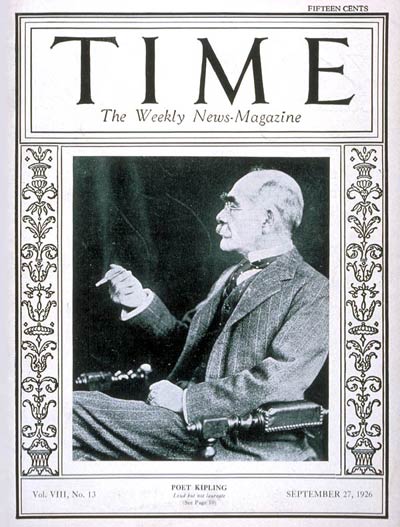
Just as Bethlehem has been exalted by the birth of a baby in a manger two thousand years ago, the Sir J.J. School of Art in Mumbai derives its historical heft from the fact that it was the cradle of the unofficial laureate of the empire, Rudyard Kipling.

Kipling, whose writings on India, it is said, bridged the gap between India and Britain more effectively than the Suez Canal, was born in the JJ compound in 1865, the year in which Mumbai's cotton boom had been teased to an impossible frenzy, turning the city into a powerhouse through which, to paraphrase a Kipling line, a thousand mills roared.

Babies have an unscripted way of stealing the show and Rudyard, or Ruddy baba as he was known, has appropriated the J.J. spotlight by the sheer fact of being birthed there. He will always be numero uno on the J.J. roster even though the only prints he ever left behind were the pug marks of the first five years of his childhood before being despatched, as was the expat tradition of the time, to the cravated confines of England. Away from his parents, ayah, household and city, he was miserable.

Despite the fact that the writer's connection with this city was more or less severed after these early years,Mumbai is loath to jettison its Kipling connection, treasuring above all, the ode where he thanks providence for allowing him to be born not in some wild rocky outcrop but in "no mean city" between the palms and the sea. In the poem, Bombay (as the city was known then) is described as 'Mother of Cities to me', a tribute which would logically make Kipling Mumbai's mowgli, or mulga, for official son-of-the-soil status.

But although this line is usually quoted when Kipling's Mumbai connection is recalled, frankly, it is a poor indicator of the emotional bond the boy shared with his birthplace. If one wants really to get an inkling of how that long journey across the seas turned him from "believer to beliefless", the story begging to be read is 'Ba Ba Black Sheep'.

It is a heart-breaking tale of a little boy Punch who has to leave Mumbai from Apollo Bunder in a P&O ship that makes him so seasick that he declares, "When I come back to Bombay.. I will come in a broom-gharri." The seasickness is only a prelude to the misery ahead when Punch is left with a disciplinarian aunt (who he initially confuses for a white ayah) who dislikes him, beats him and calls him Black Sheep. So, the last line of the nursery rhyme is altered—And none for the little boy who lives down the lane.

Critics have often commented on the strange dichotomy in Kipling's writing—on the one hand he was imperialism's chief pom-pom waver, the man who talked of the white man's burden.On the other, he shared an almost organic connection with this heathen burden and its traditions, complexity and richness. Salman Rushdie called it a conflict between two personas—Kipling Sahib and Ruddy baba. The latter sensibility, was shaped, most definitely in Mumbai.

It is as if his ghost is revisiting Mumbai in a broom-gharri now, for if you look around it is truly Kipling season, what with the recent bungalow brouhaha and Jungle Book II running in theatres across the city, and Mr Sher Khan himself putting in a real appearance by leaving a pug mark in Tungareshwar outside Bombay.

But evidence that the feeling of ownership really runs deep burbled forth last week when the students of J.J. rallied to protect what is popularly perceived as the poet's bungalow. Although city historians are at pains to point out that the original bungalow has long been pulled down, this factoid has few takers for nostalgia is remarkably free of the underpinnings of fact. Nostalgia has been leveraged to great effect—it has roused an otherwise moribund campus to action.

Once upon a time India's premier art school, J.J. has long lost its lustre, with an apathetic student body, no dean at its head and the famous bungalow uninhabited. But now, hearteningly, the voice of protest is splattering forth through posters and sitins. Ruddy, or so it would appear, has provided a much-needed rudder.

(This weekly column aims to capture that quintessentially Mumbai state of mind.)


Sunday, December 2, 2007

From Ruddy baba to Kipling sahib


The Sunday Times of India, December 2


Nina Martyris meets Charles Allen who was in Mumbai to promote his new book on Rudyard Kipling, "that most awkard, most contentious son of Bombay"

As a boy in public school in England, Charles Allen was asked as part of a classroom assignment to choose his favourite poem. Having been born in British India (Cawnpore), lived for seven years in Bihar and Assam, and grown up in a house walled with Rudyard Kipling's novels, he happily picked the barrack ballad Gunga Din.


One of Kipling's most popular poems, Gunga Din reeks of the Raj. It narrates in rhyme the story of a poor bhisti or water carrier who throws his life away to save an out-and-out racist British Tommy who, after mocking the bhisti through the poem for being a 'heathen' and a 'grinnin', gruntin' fool, finally bestows the grating tribute, "You're a better man than I am, Gunga Din."


Charles's choice of poem earned him a rebuke and a detention. "The teacher thought I was trying to be sarcastic, that I had no taste,'' he says, blue eyes still widening with traces of surprise. "You know, at that time in Britain everyone was terribly conscious of the evils of colonialism and were therefore extra mindful of India's feelings.''


Indians would be rather bemused by the English schoolmarm's extraordinary sensitivity, given that Gunga Din continues to be declaimed here with relish at the annual elocution contest. But perhaps the teacher was not all that way out either, for in the post-Independence years, Kipling was viewed as an ultraright sahib whose early thoughts on Hinduism, the Congress, and the Bengali Babu in particular (effeminate, oily, giggling) were startlingly offensive.


But therein lies the rub, for as later writers who rehabilitated the misunderstood Rudyard are anxious to point out, Kipling was a formidable paradox__Salman Rushdie calls it the dichotomy between Ruddy Baba and Kipling Sahib. "I call it the Good Kipling and the Bad Kipling,'' says Allen. "He was the ultimate shape shifter. On the one hand, an arch-colonialist, on the other, a passionate India lover who made a special trip to Bombay to see his childhood ayah and who gave the world the beloved man-cub Mowgli and the great spiritual adventure, Kim. I think of Kim as a very pro-Hindu, pro-Buddhist book''. According to some sources the name Mowgli is a corrupted form of the Marathi 'mulga' or boy, which Ruddy's ayahs must have addressed him as in Bombay.


A veteran India hand, who has written almost 20 books on India including the memorable oral history tract, Plane Tales From The Raj, Allen was in Mumbai to release his new book. Kipling Sahib is an exploration of the India chapters__Ruddy's first six years in Bombay where his father Lockwood was dean at the new Sir JJ School of Art, and his return as a teenager who is anxious, neurotic and so rude that he's thrown out of the club three times. Lahore, though, where Lockwood was stationed at the Mayo School, was a city that drew the young Kipling like moth to flame. He was utterly taken by Islam which he thought of a manly, clear-cut religion. "And he also loved wandering through the red-light quarter, he was 17 and his hormones were raging,'' laughs Allen. "He had great affection for the whore.''


But his experience of Allahabad where he joined the Civil and Military Gazette (a newspaper owned by Allen's grandfather) was painfully different. Still shattered by the Great Uprising, the predominantly Hindu city was hostile and closed to the English, and Kipling despised it. Writing with pace and an eye for detail, Allen takes the reader through the dramatic turning point when Kipling goes from hating India to falling in love with it, after he is unspeakably moved by a servant's unflinching loyalty to him when he is stricken with cholera.


Speaking at the JJ School, Allen clarified, to the disappointment of the students, that the charming green-gabled Kipling Cottage on campus was not the house in which "this most awkward, most contentious son of Bombay was born''. He was almost certainly born at the same spot but under a much humbler roof__"you could call it a jhopri or a pandal or a little shed,'' says Allen. "You see, in 1865, when he was born, Bombay was only just beginning to be built into one of the grand cities of Asia. The JJ building did not exist as we see it today, nor did any of these other huge buildings. Alice, Ruddy's mother, complained that in the monsoon the mud floor in their shack turned slushy and sprouted fungus and mushrooms.''


From his extensive research, in which he was helped by Mumbai historian Sharada Dwivedi, Allen says that while Ruddy shared a rapport with his father__the little boy used to run into sculpture class and pelt the students with lumps of clay__his interaction with Alice seemed more limited. "It was a feature of British India to dump the children with the ayahs,'' says Allen. "All we hear about Alice is her going out to a dinner party or coming back from a ride. I think she was a neglectful mother. And the proof of that is that Kipling's best writing is about orphan boys. Mowgli and Kim are both brought up by surrogate parents. And, of course, the most harrowing thing to happen to young Ruddy was to be thrown out of Eden and sent back at the age of six to England where he was miserable. Decades later, as a family man in America when his daughter Josephine died and the shutters came down, someone asked Kipling what he wanted to do. He replied, "I don't want to do anything, I want to go back to Bombay.''

Monday, August 20, 2007

When legends changed hands

THE TIMES REVIEW, AUGUST 19, 2007

During Partition, many Muslim legends like Manto had to flee India but this was compensated by Hindu greats who fled Pakistan, writes Nina Martyris

Leave now and return when the madness passes. It was this injunction, so sane then, so naïve now, that made thousands leave their homes for new homelands born under the drip of a knife. They never returned, of course, except in meaningless form, such as the grand old man of cinema A K Hangal going back decades later as part of an Indo-Pak peace delegation only to find that "nobody in Karachi remembered me". Others like Sadat Hasan Manto, the bard of Bombay, who relished the decadent glitter of the film world as much as the low life, did not survive the betrayal of the city turning on him. Manto said that he began to die the minute he left Bombay. He carried it around like a wound, and in his last years in Lahore, drunk and displaced in a mint-new Islamic state that tried him for obscenity, his singularity epitomised the irony of his most famous character Toba Tek Singh, a lunatic trapped in a No Man's Land.

In that great and tragic human exchange, Bombay and Lahore, like every other big city and town in the northern part of the subcontinent, were permanently altered, their kindness and bigotry simultaneously put to the test. Lahore, then a thriving centre of the cinema world, lost its lifeblood, as Hindu actors, directors and writers, among them B R Chopra and Pran, fled by train, plane and on foot, leaving behind the mess of homes and films unfinished on the floor. Bombay Beautiful, as Gandhi often called it, was the receptacle of this exodus of talent, though the loss of Manto alone was a debit that the sleight of account books could not balance. Employed as a scriptwriter by Bombay Talkies, then co-owned by Ashok Kumar, Manto watched in growing fear as the mood in the city darkened. The studio, which had many Muslim employees, received hate mail from Hindus saying they would set fire to the premises, a threat which Ashok Kumar pooh-poohed, calling it a passing madness. "However, it never went away, this madness," wrote Manto. "Instead, as time passed, it became more and more virulent."

Before he, his wife and two children joined the human caravan out of the city, which included many elite Muslim families such as that of Mohammed Ali Jinnah, Manto met in Bombay a man who had made the journey in reverse. B D Garga, one of India's finest film historians, whose scholarly books on cinema have enlightened audiences in India and Europe, was a Hindu in Lahore. Before Partition, Garga was already in Bombay in the employ of the famous director V Shantaram but had returned to Lahore to work on a film. There, when the madness took over, a man clutching a knife that he had used and not bothered to clean, made a terrified Garga and his Muslim cook recite the kalma to prove they were not kafirs. Thanks to his fluency in Urdu, Garga passed the test, but it broke him. "I was certain that I would be able to return to Lahore one day," says Garga on email from Goa. "That this did not happen was heartbreaking. The senes of loss is hard to describe it is associated with so many memories – of streets, trees, friends, food etc."

Days later, he too was part of the caravan, getting on to a plane and flying to the safety of a Hindu city, Bombay, which had never defined itself by any religion except money. Garga called on a bitter Manto who offered him a drink, which, it being four o'clock in the afternoon, Garga refused. The meeting is recounted in the foreword to Garga's book The Art of Cinema. Manto complained bitterly about how the management of Bombay Talkies had fired all its Muslim employees. "Wishing to cut short Manto's painful monologue, Garga asked what he had been writing of late and Manto, with a blank expression on his face, replied: 'My pen does not move on the page these days.'

Unable to afford a plane ticket was a tailor in a Karachi jail. Hangal was told that unless he left for India, he would remain in jail. With his wife, son and twenty rupees, he boarded a steamer. "I was a communist and had IPTA friends in Bombay who came to Bhaucha Dhakka to pick me up. We stayed for some time in this fellow's house and sometimes in that fellow's house." A Kashmiri Pandit – his wife was Kamala Nehru's cousin – Hangal had defied his father and refused to work for the British, learning cutting to support himself. Even today at 90, after 200 films, 60 plays and a Padma Bhushan, the old actor is inordinately proud of his "scientific cutting skills" and the enviably high salary of Rs 500 it had earned him. In the 1930s, in Delhi, Hangal had cut khaddar suits for C F Andrews ("Have you heard of him?") and Bhulabhai Desai, and in Bombay, before he became famous in Hrishikesh Mukherjee's Guddi, he had a little shop at Crawford Market, where among other things, he cut a suit for Pratapsingh Rane, who went on to become chief minister of Goa. "Many years later he saw me in Goa and he was very happy."

The director of Mughal-e-Azam, K Asif, also started out as a tailor – although as film writer Mihir Bose says in his book Bollywood A History, "He was keener on the ladies rather than making dresses for them." Asif did not leave for Pakistan, but the financier of his film, a Jinnah sympathiser, did, derailing a project that was to suffer monumental delay. Who did leave, albeit briefly, is the man after whom a bus stop in Bandra, Mehboob Studio, is named. Mehboob Khan, a Gujarati Muslim, crossed the border only to return, although no one really knows why. Bose writes that Mehboob came back to find that his studio had been declared evacuee property but managed to pull strings, get it back, and go on to make his Nehruvian classics, Andaz and Mother India.

Who did not return was the legendary singer Noor Jehan, who Manto said "had a voice like crystal", and whose departure created a vacuum that Lata Mangeshkar ably filled. Some film historians say that if Noor Jehan, who could both act and sing and whose baby wails were supposedly on pitch, had stayed, Hindi cinema might have gone down a different path, but others like Feroze Rangoonwala feel that she left because "there was no scope for her in India, her last few films like Village Girl had not done well, and Pakistan was always like a mirage holding out great hope". In Pakistan, where she had a legion following, she was given the title Mallika-e-Tarranum, which means Queen of Melody, a title that her friend "Latto" enjoys here, and who, according to Bose, spent many happy hours on the phone with Noor, singing songs and recalling the old days, before the madness.

Friday, July 6, 2007

How Israel copes with terror


The Sunday Times of India, July 23, 2006

After the Mumbai blasts, a TV anchor asked, ‘Should India go the Israel way?’ An Israeli pioneer in the study of stress has an unexpected answer


Nina Martyris

Last week in Jerusalem, we were drawn by the warmly lit window of a Chinese restaurant tucked away on fashionable Ben Yehuda Street. The door was inhospitably bolted from within, but a sign assured us that it was open. We rang the bell. A waiter answered, gave us the once-over and asked us in. Then began the routine procedure: Any weapons? A gun? Could he check our bags? Did we have an ID? Once we had been seated and profuse apologies proffered, the prickly reception receded as the table disappeared beneath platters of chicken and shitake mushrooms.

Inquisitions at restaurants and frisking at malls are de rigeur in this security-obsessed country, intensified since March 2002, after the harsh spike in suicide bombings announcing the second Intifada. Every week then delivered images of bombs and body parts. Therapists from the government’s Psychological Services, on constant call, rushed from one bereaved family to another as grief managers and safety-valves for anger.

As the attacks escalated, Ultra Orthodox Jews began an unsqueamish service called Zaka, arriving at the bomb-site within minutes to piece together shattered bodies and enable a dignified burial. Sudden death lurked in the simple act of grabbing a quick coffee. That heightened fear has ebbed — psychologists say that the initial human response to terror is a pervasive fear, which is gradually replaced by defiance and a determination to go on.

Coping with terrorism is now programmed into Israel’s genetic code. An anti-terror eco-system marries Bluetooth espionage with native intelligence and a vigilante citizenry which has learned the terrible price of ignoring an innocuous schoolbag. There are still between 10 and 20 warnings of terrorist intention every day. This daily jangle of alarm bells translates into hypersecurity, with guards poking through boots and back seats like dentists probing for cavities. This comes with its own problems. The authorities might claim that everyone is equally suspect regardless of the shape of his nose or quantum of facial hair, but local Arabs are fighting mad about racial profiling.

Even someone as venerable as Ziad Abu Zayyad, a minister in the Arafat government and now an editor, tells of the humiliation of being ordered to surrender his keys to a young Israeli soldier, probably a fresh migrant from Europe or Africa, and have his car frisked in Jerusalem, the city of his forefathers. Zayyad’s feeling of debasement and anger articulates that of the Palestinian people. A community in crisis thrust into the arms of extremism by historical circumstance and its own cynical leadership. “All the violence you see now is a symptom of Israeli occupation,” Zayyad continues, referring to the establishment of the Jewish state in 1948, a state based on biblical entitlement, sanctioned by the UN, and catalysed by the Holocaust.

To understand what the world believes to be Israel’s unbridled belligerence in dealing with its situation, academics summon their favourite word, ‘existential’. Eniat Wilf, a foreign policy expert, says that two ideas underpin Israel—the first is its pre-ordained journey through catastrophe and redemption, the second is a sense of existential fear, the legacy of 3,000 years of invasion and persecution which culminated in the Nazi gas chamber. “There is a feeling that any moment all this, everything, can disappear,” says Wilf. Iranian president Ahmadenijad played these fears like a violin with his “wiping Israel from the map” rhetoric.

“When we read the rhetoric of Ahmadenijad or Naserallah (the Hezbollah leader in Lebanon), I see the same powerful ideas that I see in Hitler. My children have a grandmother with a number on her arm,” says Arnold Roth, whose daughter Malki went to a Jerusalem restaurant and thought nothing of the young man who entered with a guitar strapped to his back. Within minutes, Arnold and his wife had become members of a club they didn’t want to belong to — the Victims of Terror.

“To be a victim of terror is not romantic, not beautiful, not transcendental, not heroic,” says Arnold. “It is not like going to a movie that has an end. By being merciful to terror we are being intolerably cruel to ourselves. When victims of terror meet, the obsessive interest is not to kill Arabs, but to find ways to ensure that our grief does not cripple our children.”

Dr Nazmi Al-Jubeh, a moderate Palestinian, attempts an explanation. “They are starving in Gaza,” he says. “There is no employment, nothing. All they do is bring children into this world and become suicide bombers. Mentally they are in siege. They have no plans when they reach 22, so they think the best is to become a martyr, get a picture on the wall or in the paper.” Both Al-Jubeh and Zayyad condemn the extremism of Hamas, but are equally clear that Israeli tanks will only worsen, never solve. And many Israelis know this too. Despite the barbed wire, the espionage, the military might, terrorism has not been defeated.

Moderate voices on both sides say that the redemption lies in dialogue, and they quote the words of the prophet Isaiah, often cited by Israel’s founding father Chaim Weizmann, “Zion shall be redeemed with justice.”

After the Mumbai blasts, a TV channel asked: “Should India go the Israel way?” Should our tolerance level be zero? Listen to the wisdom of Shlomo Breznitz, the 70-year-old professor who in 1979, started the world’s first institute to study the impact of stress on the nervous system, in Haifa. “Israel is the natural laboratory to do research,” he says drily. “I would gladly give up this advantage for a little peace of mind.” An old India hand, he continues, “One thing that Israel can learn from India is patience. Today, the role of your country as a large democracy presenting this patience to the world is very important. Please do not ever lose this.”

‘No phoney stuff. I go up on stage and sing’

The Times of India, December 17, 2005

The Blues Ain’t About A Hound Dog Crying All The Time, Says Buddy Guy

Nina Martyris

Mumbai: Buddy Guy is in India looking for a cheekbone connection. “There are high cheekbones in my family and my grandma said they must come from somewhere, must be from India. So here I am. I’ve flown all that long way—and I don’t do that no more—for just one night,’’ he says.

If you find that out of the way, get this. “Get gold. You’re going to India. Get gold,’’ he was told in Chicago. “And by someone I don’t even know that well,’’ he laughs.

India as the land of high cheekbones and gold is a refreshing change from India as a land of curry and spiritualism. One doubts whether Buddy will have time to go pottering in Zaveri Bazaar, but he does have an Indian fondness for the yellow metal. One finger is adorned with a glittering oblong, the size of a small TV, with ‘Blues’ written on it (“Just like BB’s but he didn’t have Blues on his’’), the other has a whopper with his initials (“just like BB’s but mine’s BG’’). These are complemented by a jangle of chains and a bracelet that has ‘Nothing But Blues’ scrawled in a million diamonds.

The legendary guitarist is a year shy of 70. After four decades of praise, sales, grandchildren who don’t quite believe their grandpa can play so well, and other buntings—he’s got Grammies, rolled into the Rock And Roll Hall Of Fame, taught Jimi Hendrix a couple of tricks, jammed with Muddy Waters and B B King, and got a special hosanna from a fan called Eric Clapton—he still puts it out like he’s on stage for the first time.

“I hope you’re coming for the show. I’m going to kill ‘em,’’ he says, ever the showman. He’s hoping to “kill ‘em’’ with a sitar adapted to be played standing up (you can hear it in his cover of Bob Dylan’s ‘Lay Lady Lay’), but his harried managers have not yet been able to produce one. Even the sitar-guitar is a deviation for a musician who has shunned musical gizmos and relied on the oldest technology available —the wizardry of his two hands.

“I don’t believe in no phoney stuff like lip syncing,’’ he says. “When I go on stage I sing. We grew up in a time when there was no television. We just had to go on stage and play, and that’s what I’m going to do.’’

Buddy is a name conjoined with the blues, but there’s a history here. Chess Records, his first label, fought with him because they didn’t think it was an entertainer’s name “They wanted me to add King to it, but I said no. I didn’t want to ride on B B’s name.’’ So he stuck to Buddy just like Muddy Waters stuck to the name given him by his grandma who had to scrub him clean of Mississippi delta.

Eric Clapton has called Buddy the greatest guitarist alive. But Clapton’s commercial and popular success far outstrips his. Does that give him the blues? “Okay,’’ says Guy, in the manner of one setting the record straight. “On the street, 10,000 people will recognise Eric Clapton, only one will recognise me. That’s okay. I never did let anything like that affect me. When I started out they told me that the blues was too loud and all that crap, but I’m still having fun.’’

Fun is fundamental. The one myth he’s keen to dispel is that the blues is about a hound dog crying all the time. “It’s about being happy, having fun,’’ he says, it’s about forgetting your sorrow in song. Mumbai will find out first hand tonight when he plays his two favourites, Damned Right I’ve Got The Blues and Mustang Sally.
Buddy Guy is widely known as the best exponent of the Chicago Blues. So you ask him if musicians from the Windy City have a special sound. “I never found out what Chicago Blues means,’’ he says. “It came up in the sixties. People were trying to capitalise on music. They came up with Chicago and Memphis and Motown and all that. At that time we were all just playing one thing, M-U-S-I-C. Soul, jazz, the blues—it’s all the same. It’s music.’’

Tuesday, July 3, 2007

Malegaon to Mauritius: On the trail of 1857

The Times of India, May 10, 2007

Nina Martyris

The gleaming towers of Singapore are a far remove from the squalor of Malegaon, but a common historical thread runs through both, as it does through habitats as diverse as Mauritius and Jabalpur, the powerloom townships of Malegaon and Bhiwandi and the Muslim quarters of Madanpura and Mominpura in Mumbai.

All the above-mentioned were destinations for the refugees of 1857. They came by bullock-cart and boat, by train and on foot, fleeing not only the revenge of the Company’s armies but, in many cases, the feudal oppression of the old order.

In the aftermath of the May Rising, when additional forces of British troops had been hurriedly despatched from England, the retrieval of the northern plains was executed without mercy. The main targets of the suppression were the Muslim ulema, weavers and peasants, since the British blamed them for being the masterminds behind the revolt, but the fury of the advancing armies was so terrible that no one was left unscathed and sometimes entire villages were set ablaze. Families of weavers fled from Azamgarh, Maunath Bhanjan, Mau Aima, Mubarakpur, Barabanki, Allahabad, Lucknow, Benaras, Kanpur, Tanda, Faizabad and Basti, all of them heading for the old Bombay-Agra Road which snaked down to the Deccan.

Along the way, the refugees sought protection in domains loyal to the Mughal emperor Bahadur Shah Zafar. Maheshwar, on the banks of the Narmada and a seat of power for the Holkar dynasty, was a major stop. The then ruler Ahilyabai allowed a large workforce to settle down in her territory. Further down the road came Burhanpur, a fertile belt close to the Tapi river, and then on to Dhule, Jalgaon and Malegaon in northern Maharashtra.

Bhiwandi, where the road nearly ended, proved to be a promised land of sorts, with its healthy economy and railway line running all the way to Bombay. Some families even moved into the heart of the city, to Madanpura and Mominpura, which in fact gets its name from the Momin weavers of Uttar Pradesh.

Mauritius, at that time, was a plantation colony under the British and in need of sugarcane labour. The flow of indentured labour intensified after the revolt. Migration figures are not recorded, but a Mauritian family that had migrated from Bhojpur, has records of a ship crammed with more than 500 Bhojpuris, embarking from the Kerala coast.

Writer Amaresh Misra, in his soon-to-bepublished book War of Civilisations: India 1857 points out that this Bhojpuri provenance manifests itself in popular culture. “The local language in Mauritius, Creole, is a patois of French with notes of Bhojpuri—for example, in the song ‘Hamre avion mein chal jo’ or the other common usage for ‘I love you’, ‘Je t’aime va’, where a ‘va’ is added in the way that Bhojpuri speakers say riskva or chalva,’’ he says.

Misra’s research also throws light on the migration to Singapore in 1859, when about 600 families from Gorakhpur fled to Siwan in Bihar, and on to Darbhanga and then to Calcutta. “The minister of Darbhanga financed their trip to Singapore,’’ says Misra. “In Singapore, the refugees stayed with the boat people of Malay origin, called the Orang laut. It was only years later that they got jobs as labourers and were given plots in Kampong Glam, in the eastern part of the island. Their descendants still live there. Many are still classified as working class, but others have broken out and live in the better parts of town.’’

Mumbai's Mangal and Other Mutinies


The Times of India, May 10, 2007
150th anniversary of the Great Indian Uprising

Nina Martyris

When The North Was Consumed By Violence, Mumbai And Its Surroundings Were Calm—But Not Untouched

Mumbai’s role in the 1857 mutiny can best be described as modest, but it would be unfair to say that this bustling port town with its mercantile survivor instinct was completely untouched by the slash and burn.

As a city with commerce in its veins, Bombay reacted characteristically to the news of the Rising: its stock market bucked. Wrote Karl Marx, who covered the mutiny for the New York Tribune, long distance from London, “An immediate panic seized the native capitalists, very large sums were withdrawn from the banks, Government securities proved almost unsalable, and hoarding to a great extent commenced, not only in Bombay but in its environs also.’’

Apart from this wholly natural reflex action, there were at least two sensational mutiny-related events that shook the native town to its foundations. The first was a grim cautionary lesson to prospective mutineers, handed out by the maverick police chief of the time, Charles Forjett, who ordered that two sepoys be tied to mouth of cannon and blown to bits. The other, was the charge of sedition brought against the wealthiest and most distinguished Hindu businessman of the time, the Maharashtrian banker Jagannath Shankarshet, who was implicated in a conspiracy despite enjoying the trust of the Governor Lord Elphinstone himself. In the case of Shankarshet, Forjett was once again to play a crucial role, but this time it was to exonerate not explode.

His swarthy complexion and black hair suggesting parentage that was not all British, Forjett was fluent in the local language, an expert at disguise, and often walked the streets to eavesdrop on conversations to get a sense of trouble brewing. This grassroots intelligence rarely failed him, and during the mutiny months he was more than ever on his guard. Writes historian M D David, “So tense was the atmosphere that when rumours of an outbreak of the mutiny swept the city many Europeans of Colaba fled their homes seeking shelter in the ships in the harbour, returning only when the rumours were dispelled.”

It came to Forjett’s keen ears that there was growing disaffection in the infantry and that surreptitious meetings were being held in the home of one Ganga Prasad. Blacked up and in native dress, Forjett is said to have stolen to the house in Sonapur (near Marine Lines) and heard, through a breach in the wall, the group plotting a Diwali attack on the firangis.

Forjett moved swiftly. He had two men, whom he described as the ‘ring-leaders’ arrested. The sepoys were court martialled at Fort St George and pronounced guilty. On October 15, at 4.30 pm on the Esplanade, the two conspirators, the strapping Drill Havaldar Sayed Hussein of the Marine Battalion and Sepoy Mangal Guddrea of the 10th Native Indian Regiment, were trussed with their backs to two cannon. The findings of the court were read out, the order delivered in a thundering voice, and as David writes, “There was a sharp report, a sudden flash of fire and when the clouds of smoke blew away there lay scattered the bloody remnants of the two men.”

The macabre execution took place in front of packed crowds, both Indian and European, and was Forjett’s way of broadcasting the message that any dissent would be dealt with in similar fashion.

History came round full circle a whole century later, when in Independent India, the Esplanade was renamed Azad Maidan to memorialise the numerous freedom speeches made here by Mahatma Gandhi and others. Unwittingly, but fittingly, the re-naming tributes Mumbai’s martyrs of the First War of Independence, its very own Mangal.

In those times, the practice of blowing up criminals was reserved for the most depraved atrocities. When Muslim sepoys in Delhi killed a cow and wanted to turn their swords on the kafir population, the normally mild emperor Bahadur Shah Zafar, issued an order that if any cows were killed or Hindus touched, the culprits would be tied to a cannon and blown up. This order is said to have kept Delhi’s Hindu population safe.

Meanwhile in Mumbai, there were rumblings from the hinterland. From Pune came reports of placards being strung up declaring that all Europeans should be murdered and Rs 5,000 offered as reward for the Governor’s head. The man behind this move was supposedly the Peshwa, Nana Saheb, and Jaganath Shankarshet was accused of being in cahoots with him. Shankarshet protested he was being framed by European vested interests. The story of his implication and the consternation it caused is told is great detail in Gangadhar Gadgil’s biographical novel Prarambh. Forjett, who was in charge of the investigation, came to the conclusion that Shankarshet was not guilty.

But Amaresh Misra’s book on 1857, which will soon be published, says that Shankarshet was in police custody for 11 days and even hints at ill-treatment. Says Misra, “In a family memoir, Baburao Paradkar, a descendant of Shankarshet, says that his forefather was in Forjett’s custody, and that when he came out we all knew that ‘unke saath durvivhar hua hai’. In fact, the truth is that Shankarshet was very much in touch with Nana Saheb, and Forjett did find some incriminating documents, but there was a compromise and things were worked out.’’

Monday, July 2, 2007

The Father of Harilal


THE SUNDAY TIMES OF INDIA, JULY 01

As Akshaye Khanna plays Gandhi’s prodigal son, Harilal in Feroz Khan’s Gandhi — My Father, Nina Martyris delves into one of history’s most tragic characters

Harilal was Mahatma Gandhi’s most inconvenient truth. The universal story of father and son as adversaries is only as old and tired as the institution of the family itself, but in the case of the Gandhi-Harilal contretemps it was clearly an unequal fight, with the odds quite hopelessly stacked against the son. It was one thing to buck an authoritarian father figure, quite another to be up against a political saint whose cast-iron devotion to principle and truth had a whole country in thrall.

With his stubborn morality, sexual abstinence, and faddish lifestyle, Gandhi was a difficult parent. He is perhaps the only upper-middle-class Indian father ever to have sat his four sons down and pointed them to a range of glorious career choices, from farmer and cobbler to weaver and scavenger, and to be deeply disappointed by their bourgeoisie desire to be lawyers and journalists.

The younger sons, Ramdas and Devdas, were indulged chiefly because by the time they had come of age, Gandhi is said to have learned from his earlier mistakes and scaled down the unrealistic levels of expectation. The two older boys, Harilal and Manilal, were in a sense the guinea pigs of his radical world view and this affected them deeply. All his life Harilal struggled against his father’s magnificent impartiality and refusal to favour his own children above anyone else’s in the settlement. And so a scholarship to study abroad, which might have changed the young man’s life, was passed on to a distant nephew. It was a hard blow and the early seeds of discord were sown.

The ill-starred Harilal is back in the news as a result of the soon-to-bereleased film, Gandhi — My Father. Director Feroz Khan, who is revisiting a subject that he first tackled with remarkable sensitivity in his play Mahatma Vs Gandhi, once more interrogates this vexed relationship.

The film is based on Chandulal Bhagubhai Dalal’s fine book Harilal Gandhi: A Life (Orient Longman), acknowledged as the most authentic documentation of the Mahatma-Harilal relationship. Khan calls it “the Gangotri”. The film opens with Harilal’s death, him being scraped off the streets in Mumbai and carried to Sion Hospital. He is so far gone that he can barely say his name, and when asked for his father’s, can only manage “Bapu”. Impatient with his delirium, the doctors tell him Bapu is the whole of India’s father. What is your father’s name? Ironies of this kind strafe the film. If khadi was an article of faith for Gandhi, his son hawked foreign cloth. If non-violence was the touchstone of his father’s philosophy, Harilal’s business at one point depended on the continuance of World War II. Peace brought with it ruination.

Unable to bear that his essentially good-hearted son had fallen among thieves, Gandhi publicly cut ties with him. And when Harilal, whose insolvency made him a prime candidate for being appropriated, crossed briefly to Islam and became Abdullah, his father struck back with an editorial in Harijan, accusing him of converting on specious grounds, of being addicted to the bottle, and of visiting houses of ill-repute. The conversion is said to have broken Kasturba’s heart.

That there was some sort of unspoken blacking out of Harilal from Gandhi’s daily world is evident from the fact that his faithful secretary Mahadev Desai, meticulous in all else, is almost completely silent on Harilal. Gandhi, too, chose to tear up the letters written to him by his son. Fortunately for us, Harilal preserved his father’s numerous missives, which, along with his own letters to his wife Gulab and sister-in-law Balibehn, remain the most valid route to understanding him.

But it is thanks to the first-person account by Mahadev’s son Narayan Desai that we are privy to the most gutting encounter between Gandhi, Kasturba and Harilal at Katni station. Harilal has begged for an orange and brought one for his mother. When asked by his Bapu if there is one for him too, he replies, “No, nothing for you. All the greatness you have achieved is only because of Ba. Never forget that.” And as the crowd shouts slogans in praise of Gandhi, a quavering, defiant voice is heard above the din, “Kasturba ki jai.”

Wednesday, June 27, 2007

A post-mortem of John Company

THE SUNDAY TIMES OF INDIA, JUNE 18, 2006

The Corporation That Changed The World
Nick Robins
Orient Longman

Nina Martyris

If multinationals believed in ancestor worship, they would have to genuflect before the first forebear, the Honourable East India Company. John Company, which began with a trading post in Surat in 1608, grew to become the virtual government of India and helped several generations of adventurers to ‘shake the pagoda tree’ until it was finally sent packing, 250 years later by the British Crown.

The Company’s reign, for the most part, was distinguished by plunder, human rights abuse and systematic extortion, resulting in a crippling famine and a bloody insurrection. In particular, it is remembered with horror for being the white leech that bled the wealth of Bengal, beggaring it beyond description and forcing its master weavers into mutilating their own thumbs to escape its oppression. As Jawaharlal Nehru wrote with a rare stab of anger in his otherwise stately Discovery of India, what better measure of this misrule than the East India Company’s contribution to the English lexicon—the Hindustani word, loot.

The scale of corruption in John Company and the lavish nabob lifestyle of its petty clerks so appalled those in the home country that in the early 1800s, the leading utilitarian thinker Jeremy Bentham proposed to Parliament that two statues be raised in London—one of the corrupt governor general Warren Hastings, and another beside him, of a “long-robed accomplice lodging a bribe into his hand”. The proposal, regrettably, was not passed, but it indicated the open contempt in which the Company men were held, not least by a young Karl Marx, who went on to write his seminal history of the First War of Indian Independence.

The brutality of the 1857 uprising shook Britain in much the same way that 9/11 shook America. The Times could scarcely contain its outrage. The defence came from Marx who wrote in The New York Tribune, “However infamous the conduct of the Sepoys, it is only the reflex, in a concentrated form, of England's own conduct in India. To characterise that rule, it suffices to say that torture formed an organic institution of its financial policy.”

In The Corporation That Changed The World, British historian Nick Robins takes an unsparingly critical stand. He tracks the EIC's growth from the merchants’ landing in Surat in 1608 not as conquistadors with flag and drum but as commercial supplicants who went from strength to strength using all the tricks of corporate warfare—an unprecedented tax holiday (the 1717 firman from the Moghul emperor absolved them of paying taxes), monopolistic rule (no other British merchants were allowed to trade from Indian ports), mergers and creeping acquisitions (annexations through warfare, forgery and guile), and the free-for-all of capitalism (mercantilism as it was then called).

There is an uncomfortable resonance between this vocabulary of ills and the malaise afflicting today’s big corporations such as Microsoft and Enron, accused of monopolistic bullying and, in the case of the latter, cooking the books. Robins makes these linkages to assert that his primary purpose in doing a post-mortem of a colonial company is to show how the East India seed has impregnated and shaped the modern corporation. He calls for checks and balances—say an international court—to control the otherwise unstoppable march of big corporates, some of which are so bewilderingly huge that they are above country-specific law. It is vital, he says, for us to always, in the ringing words of Edmund Burke, “Remember! Remember! Remember!”

A popular history, written in a lucid, ironic style, Robins’ book is held together by its singularity of vision. The structure, the selection of material, and the laser sharp moral stance are all governed by the author’s one aim—to inform and convince that the EIC was a blackguard of the deepest dye. His view is quite at variance with the renewed romanticism that the East India Company is being invested with in this era of globalisation, with the captains of free trade holding it up as an icon of corporate adventurism and inspiration. Robins reminds that the EIC was but a “rump of unconstitutional power”.

There are many, Indians not least, who will argue that the John Company was not all bad, that its contribution to the social and cultural landscape of India was substantial—from much-needed reform such as banning sati and child marriage to the translation of ancient scriptures, setting up of literary societies and introducing the concept of modern schooling. Bombay, too, benefited under enlightened governors of the early 1800s like Mount Stuart Elphinstone and John Malcolm.

To this hymn of praise, Robins has a sharp retort. These good deeds are but a bundle of rags when weighed against what the Company should be judged for—its role as de facto government of India, a responsibility it grievously abused. Corporates, he rightly says, should be judged not by peripheral acts of philanthropy but by their core business activities. Union Carbide can play Santa Claus to all the orphanages in the world, but it still needs to atone for the industrial crime of Bhopal. Moreover, if at all Indians remember British rule with vestiges of love—for the Railways, the English language, the administrative machinery—he points out that most of this institution building took place in the post-Company phase, when public works replaced plunder.

But Robins has gone so fiercely native in his choice of prism that he glosses over the role played by the Indians themselves, who sold compatriots and country over and over again. Treachery and self-profit have as much a role to play in the chains-and-dust tale of India as British imperialism. And not much has changed, especially on the self-profit front. The deal that the now-disgraced Enron struck with the Maharashtra government ten years ago is only one sign that the dubious legacy of the East India Company is alive and well.

Namdeo Dhasal: the bard of Mumbai's underbelly

THE SUNDAY TIMES OF INDIA, JUNE 24, 2007

NINA MARTYRIS


Namdeo Dhasal’s poetry has often been called a translator’s nightmare, a kind of fecund waste land where even the most resolute could lose their way. There is so much going on at different levels in his writings: at all times there is the anger of the damned, the rhythm is complex, and the verse a mongrel patchwork of dialect, including Bambaiya and Mahar, through which courses the excretion of human and city life. There is more sepsis here than in the Mithi, and Dhasal wants more than anything else to slam- dunk the reader’s head into its flow.

This, after all, is the venting of a man who famously described himself as “a venereal sore in the private part of language’’.

Down the years there have been sporadic attempts to translate Dhasal for anthologies and journals, and although some of these efforts are stamped with an academic acuity, the rasp and scat of the original haven’t always made the leap. Scholars have rued the poor cross-pollination, for it has meant that one of the country’s leading Dalit voices has remained beyond the reach of readers not fluent in Marathi.

Setting things right by a long way is the recently published large-format book, Namdeo Dhasal: Poet of the Underworld, with the eminent bilingual writer Dilip Chitre as literary curator and translator. Handsomely planned with plenty of breathing room, the poems are interleaved with black-and-white photographs of Mumbai at its most un-picture-postcardlike, and therefore most riveting, although the quality of the photos is disappointing.

The book is the result of an interesting four-way collaboration: Namdeo the poet, Chitre the translator, Henning Stegmuller the photographer, and stitching it all together between hardcovers was publisher S Anand. “This is the first comprehensive volume representing Namdeo’s entire oeuvre by a single translator,’’ says Anand, who has won the British Council’s International Young Publisher of the Year award for the title. “This book is Dilip’s baby. After I won the award, I called Dilip, only to find out that he was with Namdeo in the ICU. Namdeo has had myasthenia gravis for two decades and keeps very poor health. When his wife Mallika showed him the book, I believe his face lit up. He is now convalescing at home but is far from his normal self.’’

What binds the members of this project is not the mere act of poetry-making but the deeper reality of Dalit oppression. Chitre’s 40-year friendship with Dhasal—a friendship that has survived substantial political differences—is rooted in a shared belief in a Dalit renaissance. The Chennai-based Anand who had launched his publishing imprint Navayana specifically to engage with the politics of caste, read an article by Chitre on Namdeo’s poems when he was awarded the Golden Jubilee Sahitya Akademi award in 2004, and decided that he had to commission a comprehensive translation.

Although all eight collections of Dhasal’s works are represented, many of the poems are from his landmark collection Golpitha (1972), set in Mumbai’s redlight district where he grew up. The underworld of the book’s title is not the glamourous pad of the don and his moll, but the polluted world of the pimp, the thug and the harlot. The poet plants his flag in Mumbai’s prostitute heart and in a brazen celebration unfurls its debasement for the reader and the world to see. It is an intimate stripping, a blasting open of memory.

During the famous 1960 London cersorship trial to ban D H Lawrence's Lady Chatterley's Lover, the prosecution came armed with a smug obscenity count: the word 'fuck' or 'fucking' appeared 30 times, 'cunt' 14 times, 'balls' 13 times; 'shit' and 'arse' six times each, 'cock' four times, 'piss' three times. A single poem by Dhasal could easily top that count.


If Dhasal's poetry is guilty of excess, and it is, it is only because he is the inheritor of a civilisational injustice, a system which considered his parents and their ancestors to be less than human. The outpouring of rage and cuss words in his long poem Man,You Should Explode, is the howl of a desperate soul. Like a man possessed, the poet incites the reader into all kinds of violent and unspeakable acts.

Turn humans into slaves; whip their arses with a lash
Cook your beans on their bleeding backsides
Rob your next-door neighbours, bust banks
Fuck the mothers of moneylenders and the stinking rich
Cut the throat of your own kith and kin by conning them; poison them, jinx them
You should hump anyone’s mother or sister anywhere you can
Engage your dick with every missy you can find, call nobody too old to be screwed
Call nobody too young, nobody too green to shag, lay them one and all

The tirade, some of it gratuitous, continues like a foul river in spate, until, spent of it spleen, the tone changes in the last few lines into a brooding and meditative calm, a post-apocalyptic wisdom that now encourages the same reader to reach into his or her deepest self and "act so bright as to make the Sun and the Moon seem pale". It is a poem that leaves one both frightened and hopeful, revulsed and ashamed.


Dhasal may live today in middle-class comfort, and his militant political party, the Dalit Panthers, may have long been tamed, but these poems were written before that softening. Like the great Tudor politician Cardinal Thomas Wolsey, Namdeo grew up as the son of a butcher, and his world was not a pretty one. The backdrop of the cover of Golpitha was a municipal form of a Venereal Diseases Clinic. Wrote Vijay Tendulkar in the foreword, “The world of Namdeo Dhasal’s poetry begins where the frontier of Mumbai’s white- collar world ends and a No Man’s Land opens up.’’

This elegant book is a journey through the bowels of those quarters over which we have constructed robust mental flyovers.

Sunday, April 22, 2007

Leonard Cohen came looking in Mumbai...and found some answers amidst the garbage and the flowers


NINA MARTYRIS

In the beautiful waste land that Leonard Cohen inhabits it is “permanently winter without Christmas”, to borrow a phrase from CS Lewis’ Narnia series. In his below-the-belt baritone that can barely hold a tune, the Canadian singer has taken continents of worshipful listeners on brooding tours of the tundra of the soul. Death, betrayal and unrequited love are the pit stops, often even requited love. The 71-year-old musician’s legion fans make for a broad church indeed: from hyper teenage girls eager to lose themselves in lyrical pain, to political toughs like Sanjay Gandhi whose taste apparently ran to Bird On A Wire and Suzanne, to toffs like Prince Charles who said “Len Cohen” on a television show when asked to name his favourite singer, only to have young Prince William, also on the show, pipe up with “Is he a jazz player?”

No, but the blues are certainly the colour of Cohen’s mein, mostly a dark navy but frequently leavened with a robin blue whenever his arctic wit mocks forth. After all, policing the porous borders between pain and pleasure is an exacting business and suddenly in the middle of a lament on human frailty, old Len will allow spring to burst in like a clown and ruin the funeral. This in fact is the best part about his songs and poems — the ice-light zone where the requiem and the risque, the sad and the funny leak into each other just as they do in real life:

drinking cognac
with the old man
his exquisite hospitality
in the shack by the river —
that is, no hospitality
just emptying the bottle into my glass
and filling my plate
and falling asleep
when it was time to go


It is this grizzled, Jewish wit that his latest offering twinkles with. Cohen has just published his second collection of verse, Book of Longing, which, he said dryly in a radio interview, should have been called Book of Prolonging, given the twenty years it has taken to hatch. A handsome edition that any Cohenhead would love to own, the volume is studded with teasing sketches and doodles from the singer’s pen. Many of the poems have already been set to music and form part of his previous albums. But of special interest to his Indian fans is the scattering of poems set in Mumbai, an unlikely Mecca for a man searching for the larger answers to life, but to which Cohen turned after being somewhat disillusioned by his sabbatical in a Zen monastery. Ten years of austerity at Mt Baldy in Los Angeles in the service of his master Kyozan Joshu Roshi came to an end when the troubled troubadour found that the base desires he had sought to escape only thrived on the rare mountain air.

I shaved my head
I put on robes
I sleep in the corner of a cabin
sixty-five hundred feet up a mountain
It’s dismal here
The only thing I don't need
is a comb

Only Cohen could compress a world of irony into that one bald line “The only thing I don’t need is a comb”. Solace of sorts, even an entry point into understanding the contradictions of life, arrived through an unexpected route — at an up scale Breach Candy apartment, at the feet of the venerable Ramesh Balsekar, a retired banker turned philosopher-guru who didn’t even know who the old man in his morning audience was until his grand daughter hysterically informed him that this was the Prince of Darkness himself. The guru’s robust optimism was more than a match for Cohen’s mournfulness and the two became friends. “Ramesh has saved my life. I was dying in that monastery,” Cohen later told a friend, after many expoundings on Balsekar’s central theory which, like all complex thought, comes disguised in beguiling simplicity — that happiness, which is the human aim, can be achieved if one does not blame oneself or others for any happening, good or bad.

“I heard many interesting and precise ideas, which later I blurred into verse, while in the precious company of Kyozan Joshu Roshi, and Ramesh S. Balsekar. Their compelling concepts were so imperfectly grasped that I cannot be accused either of stealing or absorbing them,” wrote Cohen in the acknowledgments.

In Mumbai, he divided his time between Balsekar, the Breach Candy Club (from whose waterfront he watched the “perverse repetitions of the Arabian Sea”), walking the streets and visiting the old blue synagogue at Kala Ghoda. One of the recurring themes in this collection is his coming to terms with old age and its many humiliations. Nowhere are the intimations of mortality more poignantly felt than in this poem written in the prosaic digs of the Kemp’s Corner Hotel, a pokey, over priced lodging, where Cohen put up and on whose stationery he drew some sketches which he later presented to Balsekar:

My time is running out
and still
I have not sung
the true song
the great song

I admit
that I seem
to have lost my courage

a glance at the mirror
a glimpse into my heart
makes me want
to shut up forever

so why do you lean me here
Lord of my life
lean me at this table
in the middle of the night
wondering
how to be beautiful

This sunset angst is at a variance with the passion that pulses through the other poems in the book, dense with the tug of a young man’s longing (the singer has found love again with his singer-partner Anjani Thomas). And for the hyper young Indian female fan, here’s the ultimate tribute:

India is filled
with many
exceptionally beautiful women
who don’t desire me
I verify this
every single day
as I walk around
the city of Bombay
I look into face after face
and never once
have I been wrong

Book of Longing. LEONARD COHEN. MCCLELLAND & STEWART

The Times Of India, Mumbai, Bookmark, 20 Aug, 2006.

Snap Shots

Get Free Shots from Snap.com

Labels

Blog Archive